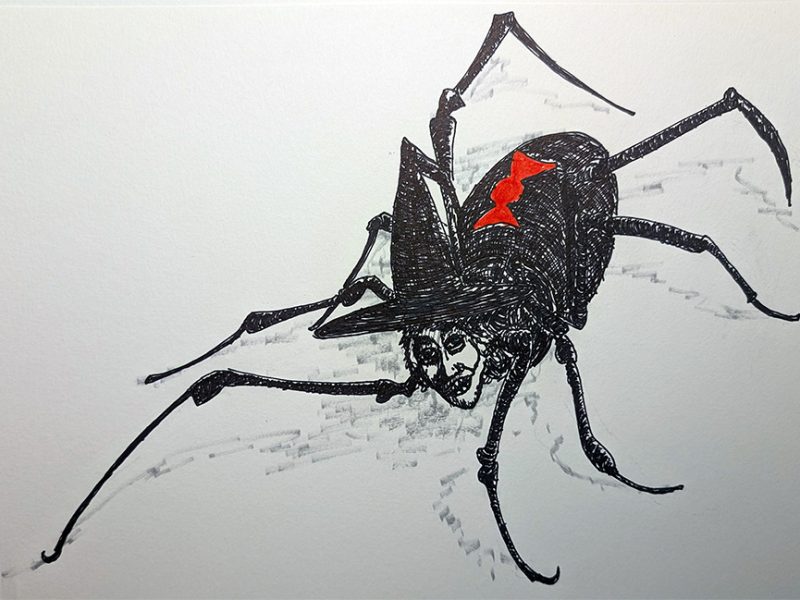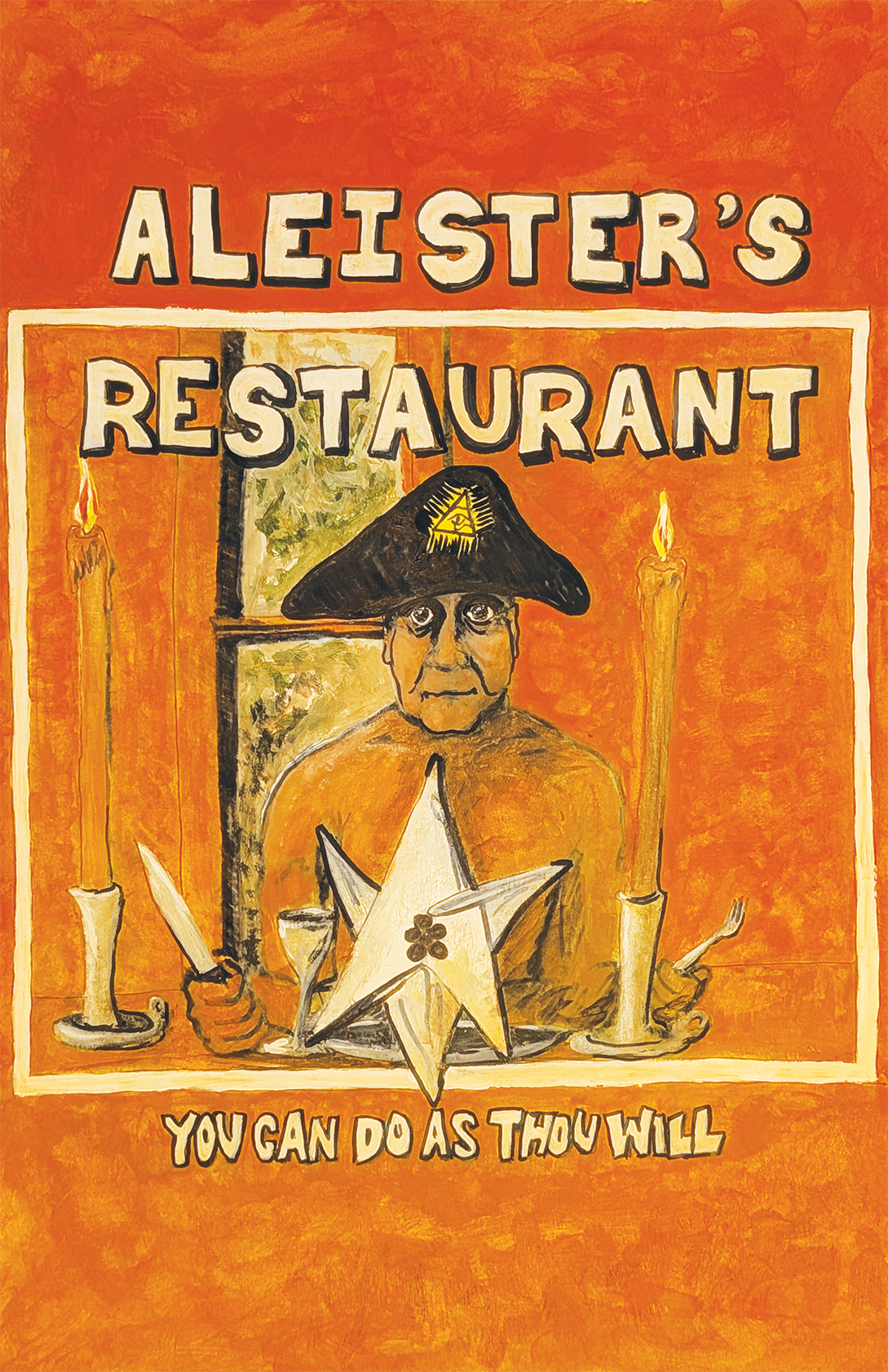
I painted for the first time in who knows how long.
All because I wanted to make a mash up meme and brobot has too many guardrails to do this one right.
So I did the old school thing and hand sketched, painted, and lined this parody poster.
I am going to make it available as a teeshirt and print…one of these days. For now. Enjoy.
Here is the rewrite of the classic Alice’s Restaurant, to be performed to the tune of the same name that brobot wrote for me to make this image complete.
“Aleister’s Restaurant (An Occult Massacree)”
(spoken intro, slow guitar vamp)
This song is about a man. And not just any man. This is about a man who decided, at a very young age, that the normal rules were optional.
And once you decide that, well… things tend to escalate.
Verse 1
Now Aleister Crowley was born in England, which already puts you at a disadvantage, and he grew up very religious, which meant he spent the rest of his life trying to cancel that out.
His parents said, “Be good,” and he said, “Define good.” They said, “Don’t summon demons,” and he said, “Well now I gotta check.”
So he read books, and wrote books, andread more books, and then wrote even more books about reading books, and eventually decided that God was real, but very negotiable.
Refrain(spoken-sung, loose)
And you can find just about anything if you go down Aleister’s way,
Incense, rituals, questionable life choices, and a bill you’re still paying today.
You don’t need directions, just follow the ego and noise, ‘Cause Aleister’s way is a long strange trip powered mostly by confidence and bad decisions.
Verse 2
Now Aleister liked mountains, and drugs, and magic, sometimes all at the same time, which made the mountains very interesting and the magic very conversational.
He joined secret societies, then got kicked out, then made his own secret society, which is usually how that goes.
He said, “Do what thou wilt,” which everyone else heard as, “Oh great, here we go,” because when someone says that out loud, they’re about to explain it for three hundred pages.
Verse 3
He traveled the world, writing poetry nobody asked for, performing rituals nobody approved, and upsetting governments that would’ve otherwise left him alone if he’d just stayed quiet.
But Aleister did not stay quiet. Aleister never stayed quiet. Aleister stayed busy.
He climbed mountains just to say he did, started religions just to see if they’d stick, and made enemies in multiple countries without ever technically declaring war, which is honestly impressive.
Refrain
And if you wander down Aleister’s way, you’ll hear some stories you weren’t expecting, Some true, some exaggerated, some written while absolutely not sober.
You might learn a spell, you might lose a friend, you might gain a reputation you didn’t plan on, But you’ll definitely leave with a strong opinion about Aleister Crowley.
Verse 4
Now the newspapers said he was evil, and the churches said he was worse, and the government said he was suspicious, which usually means interesting.
They called him “The Wickedest Man Alive,” which he absolutely framed and hung up, because if you’re gonna get a title like that, you don’t waste it.
He said magic was just science that hadn’t learned manners yet, and religion was just poetry
that took itself too seriously, and somehow convinced enough people to listen.
Verse 5
And eventually Aleister got old, which surprised everyone, including Aleister.
He slowed down a bit, but not much, and died the way he lived: argued about, misunderstood, and still being quoted by people who definitely hadn’t read the whole thing.
Final Refrain
(long, meandering)
So if you ever hear someone say, “Who was Aleister Crowley, anyway?” You can say,
“Well, he was a poet, a magician, a mountaineer, a philosopher, a menace, a genius, and a walking argument.”
And if they still don’t get it, just tell them to take a long walk down Aleister’s way, bring a sense of humor, and don’t take everything literally, especially not the parts where he meant it that way.
(spoken outro)
And that’s the story. More or less. Depending on who’s telling it.
You can sing it any time you want.
Just don’t blame me if people start asking questions.
This painting is a gouache piece with watercolor line work, built like a deliberately overloaded album cover. The composition borrows the familiar staging of a folk-era group portrait, then pushes it sideways by dropping Aleister Crowley into the frame as if he belongs there—casual, centered, and completely unbothered.
Gouache gives the image its flat, poster-like color fields, while the watercolor lines keep it loose and slightly unstable. Nothing is over-rendered. Edges breathe. Figures feel arranged rather than posed, which helps sell the sense that this is less a scene than a moment paused mid-joke.
Conceptually, the painting lives in the overlap between counterculture, parody, and reverence-for-the-absurd. Sacred imagery, pop iconography, and folk nostalgia sit side by side without hierarchy. The humor comes from the confidence of the placement, not from exaggeration—Crowley isn’t mocked or elevated, just treated as another cultural artifact dropped into a shared visual language.
It’s meant to read quickly, like a record sleeve you recognize before you remember why, and then linger as the details start to register. A familiar structure, quietly misused on purpose.